
By James McIntyre, CCXP
Artificial intelligence hasn't just improved the customer journey. It has compressed it, fragmented it, and partially handed control to algorithms.
Yet while investment surges, results lag. MIT research found that 95% of generative AI pilots have failed to deliver measurable P&L impact. At the same time, Zendesk reports that 83% of consumers believe customer experience should be better than it is today.
We are no longer managing linear funnels or even omnichannel journeys. We are managing an ecosystem of machine-influenced decisions, off-platform commerce, predictive service, and rising customer expectations, all moving faster than most operating models can handle.
AI is accelerating opportunity. It is also accelerating risk.
The question isn't whether AI will reshape customer experience. It already has. The question is whether your organisation's strategy, governance, and commercial discipline are keeping pace.
Discovery, evaluation, purchase, and service are collapsing into fewer steps, often happening simultaneously.
Discovery is no longer SEO-first. Customers increasingly begin with AI-generated answers, curated feeds, community recommendations, and algorithm-driven suggestions. In many cases, they are shown a summary, not your website.
Marketing leaders are no longer competing solely for search ranking. They are competing for algorithmic inclusion. Commerce is increasingly off-platform, from embedded social shopping to marketplace ecosystems and in-app transactions. The journey can now be completed before a customer ever reaches an owned channel.
AI-driven recommendation engines shape not only what is seen, but what is purchased.
Service is now predictive and automated. AI agents triage queries, resolve simple requests, and escalate only when required. But as AI becomes a participant in the journey, expectations rise.
Customers increasingly expect immediacy, personalisation, and seamless continuity across channels. Speed has improved, but trust has not automatically followed.
AI is amplifying both excellence and incompetence.
Many organisations are experimenting. Fewer are seeing measurable commercial return. The issue is not necessarily the technology. It is the operating model around it.
AI initiatives are often:
Meanwhile, customers judge AI differently than businesses deploy it. They don't evaluate sophistication. They evaluate lived experience.
Was it faster? Was it fair? Did it respect me?
Customers embrace AI when it enhances their journey but reject it when it feels cold or poorly designed. At the same time, trust and personalisation have become central drivers of loyalty.
AI can enhance both. Or undermine both.
Despite the acceleration, some fundamentals remain constant. Not all moments are equal.
Certain interactions carry disproportionate weight: the first trust-building interaction, the first automated service experience, the first failure, and the renewal or churn decision.
AI does not remove the need for prioritisation. It makes it more critical. When automation scales poorly, small problems can quickly become systemic.
I worked recently with a retail brand where I uncovered an automation agent delivering more than 30,000 "off-brand" experiences to customers each month.
This is why customer leadership in the AI era is less about experimentation and more about disciplined orchestration.
Journey mapping remains one of the most powerful tools for understanding customer experience. What has changed is the nature of the journey itself.
Customer journeys are no longer simply sequences of human touchpoints. Algorithms recommend, AI agents respond, and predictive models trigger lifecycle engagement. Machines are now active participants in the experience.
This means the journey is a dynamic system that must be orchestrated and governed across data, technology, and teams.
Through working with growth-stage and enterprise brands, I've found that successful AI-enabled CX transformation consistently follows a structured path.
Most organisations map the journey they think exists. Few map the journey customers are actually experiencing. That means including AI-influenced discovery, off-platform purchasing, automated service loops, and data-driven personalisation triggers. Machines must be included in your journey architecture. If you don't map algorithmic touchpoints, you cannot manage them.
Not every touchpoint deserves equal investment. Use data to identify high-churn friction points, moments that influence trust, service interactions that drive cost to serve, and triggers that affect retention. Prioritisation separates transformation from experimentation.
AI use cases are abundant. Strategic focus is not.
Before deploying, ask: Does this reduce friction? Might this increase trust? Does this improve retention or revenue? What is the risk if it fails at scale? Avoid the pilot trap. The failure rate of AI pilots is not only a technology problem. It is also a prioritisation problem.
AI fails in silos. Marketing automation, service platforms, CRM, loyalty programs, and digital analytics must connect. Contextual intelligence depends on unified data. Experience orchestration must replace campaign orchestration.
Vanity metrics will not secure executive confidence.
Move beyond open rates, click-through rates, and standalone NPS. Track retention lift, cost-to-serve reduction, first-contact resolution impact, revenue per customer, and lifetime value improvement. Leaders who tie AI initiatives to commercial performance gain strategic influence.
AI governance is not optional. Without clear ownership, initiatives stall or grow without cohesion. Assign end-to-end journey owners, a commercial sponsor, and AI governance oversight. Governance is what separates pilots from payback.
Do not deploy AI everywhere at once. Start where friction is highest, volume is greatest, and commercial upside is measurable. Scale only when outcomes are proven.
Automation should remove friction, not empathy.
Customers still want human escalation when complexity or emotion increases. AI should enhance human capability, not replace human judgment. The brands that win will design blended systems where technology handles efficiency and humans handle complexity.
The temptation in the AI era is to chase innovation. The discipline required is to architect coherence.
The organisations that succeed will not necessarily be those that deploy the most AI tools. They will be those that redesign their operating model around customer impact, prioritise moments that matter commercially, embed governance before scale, and align AI initiatives to revenue, retention, and efficiency.
AI accelerates everything. Including bad strategy.
For customer leaders, the role has evolved from campaign leader to experience architect. The customer still needs to be at the centre. The difference now is that the system surrounding them is faster, more complex, and partially autonomous.
Your job is to ensure it is coherent, accountable, and commercially aligned.
Because in the AI era, growth will not come from automation alone. It will come from disciplined orchestration.
James McIntyre, CCXP works at the intersection of customer experience, loyalty, data, design, and delivery to help organisations unlock customer and commercial value.
Course Description Understanding and addressing differentiated customer needs is essential to delivering experiences that support business success. In this course, you will explore how to build customer-centric strategies that reach broader audiences and create measurable impact by applying the five competency areas of the CXPA CX Framework. You will learn how to refine data-collection methods, develop actionable personas, apply inclusive design principles, and integrate market-driven CX innovations. The course also examines why some customer perspectives are often missing from traditional CX strategies and how organizations can begin closing those gaps. You will explore methods for tracking key performance indicators, demonstrating financial outcomes, and engaging decision-makers and stakeholders to build support for more inclusive customer experiences. By the end of the course, you will have a clear, structured approach to strengthening CX strategy—one that aligns with business priorities and helps ensure that a wider range of customer perspectives, including those previously overlooked, are heard, understood, and incorporated into experience design and organizational decision-making.
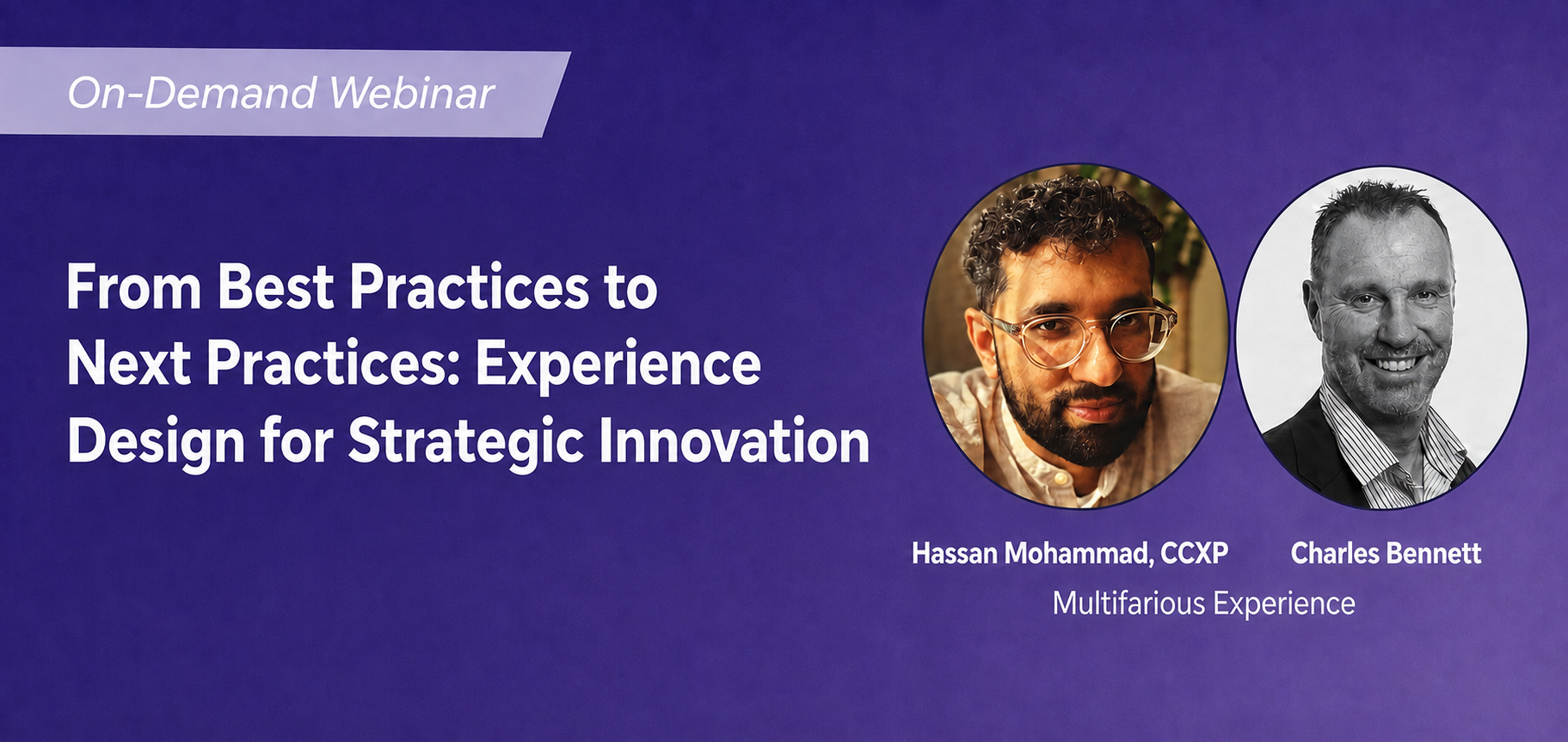
Hassan Mohammad, CCXP and Charles Bennett share outcome-based, journey-centric approaches that move past "what happened" metrics to uncover customers' deeper goals and emotional drivers.

In this CXPA webinar, you'll learn how traditional CX tools can overlook neurodivergent customers and how to design more inclusive, flexible, and human-centered experiences.

Making Personas and Journeys Data-Driven and Actionable Making Personas and Journeys Data-Driven and Actionable Course Description Together, we will explore how to make personas and journeys more…